The Diwan
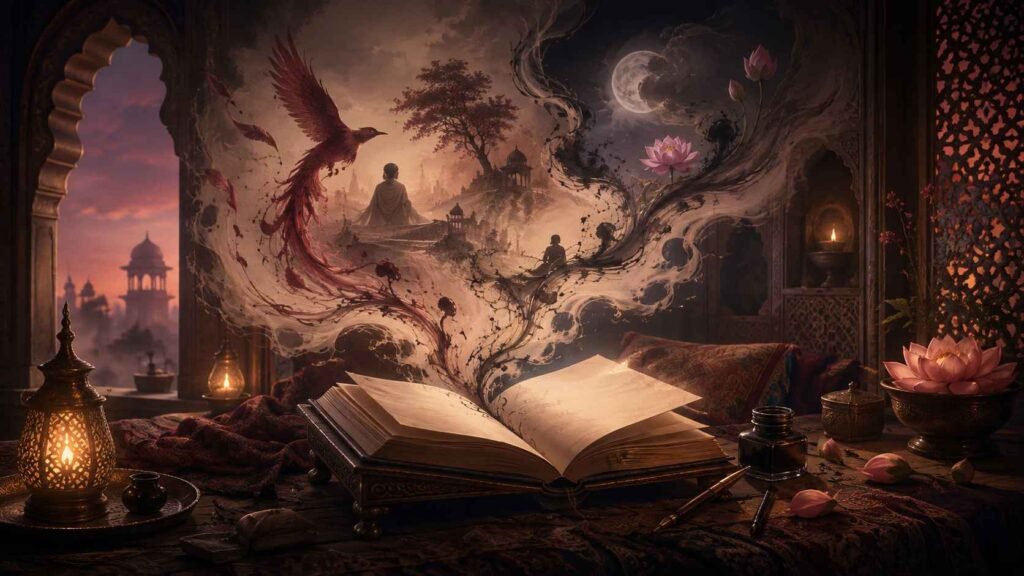
Ink and Echoes
A Diwan is more than a collection of verses. It is a journey through thoughts, emotions and experiences preserved in words.
Welcome to The Diwan, a space where poetry becomes memory, reflection becomes language, and emotions continue to echo long after the final line has been read.
For me, poetry often begins with something simple—a feeling, an observation, a silence, a conversation or a moment that refuses to disappear. The poem becomes a way of holding that moment and allowing it to speak again in another time, another place and perhaps to another heart.
That is the spirit behind Ink and Echoes.
Where Emotion Becomes Verse
Poetry has the ability to express what ordinary conversation sometimes cannot.
A few lines can carry longing, affection, separation, hope, introspection, resilience or the quiet beauty hidden within everyday life. Some emotions arrive suddenly, while others remain within us for years before finally finding their words.
The Diwan brings together these different shades of expression.
Each piece begins with its own emotion and develops its own rhythm, voice and identity. Some verses invite contemplation, some are meant to be heard aloud, and others simply ask the reader to remain with them for a moment.
Two Languages of Identity, Two Literary Journeys
My poetry travels through different languages and literary traditions, each offering its own character and emotional vocabulary.
Surkhbaaz — सुर्ख़बाज
For my Hindi and Urdu creations, I write under the takhallus Surkhbaaz (सुर्ख़बाज).
The name reflects a fearless pursuit of emotion, imagination and poetic expression.
Through Surkhbaaz, the world of Hindi and Urdu poetry becomes a space for exploring relationships, memories, questions, longing and the many contradictions of human experience.
The musicality of language, the movement of a thought and the emotional impact of a well-placed line are all important parts of this literary journey.
Pankeruh — पंकेरूह
My Marathi ghazals carry the pen name Pankeruh (पंकेरूह).
The name is inspired by the lotus—a flower that rises from the mud yet remains untouched by it.
For me, that image represents resilience, hope and inner beauty.
The poetry of Pankeruh draws from emotions and observations that feel deeply personal yet remain universally recognisable. Through Marathi, these experiences take on a different rhythm, cultural intimacy and emotional texture.
Poetry That Continues Beyond the Page
A poem does not always end when it is written.
When a reader discovers a verse, it begins another journey. A line may remind someone of a forgotten memory. A ghazal may express something they have always felt but never found the words to say.
This continuing conversation between the poet and the reader is what gives poetry its lasting life.
The ink belongs to the writer.
The echo belongs to everyone who finds a part of themselves within those words.
Inside The Diwan
The Diwan is intended as an evolving home for selected original poetry and literary expressions.
Readers can explore work across different languages, moods and poetic experiences, including:
Hindi & Urdu Poetry
Original poetic expressions written under the name Surkhbaaz, shaped by emotion, reflection and the rich lyrical character of Hindi and Urdu.
Marathi Poetry
Original Marathi poetry and ghazals written as Pankeruh, carrying themes of resilience, relationships, reflection and inner experience.
Ghazals and Lyrical Expressions
Verses where rhythm, structure and emotion work together to create poetry that can be both read quietly and experienced through recitation.
Reflections in Verse
Poetry inspired by moments, memories, conversations, journeys and observations from everyday life.
From Silence to the Written Word
Every poem has a moment before the first word appears.
Sometimes it is a thought during an ordinary day. Sometimes it comes through music, travel, a conversation or a period of silence. At other times, an emotion waits patiently until language finally becomes available for it.
Writing is the process of listening to that moment closely enough to recognise what it wants to become.
The Diwan preserves those moments in verse.
Poetry as a Conversation
I do not see poetry as a one-sided expression.
The poet may begin the conversation, but the reader completes it.
The same verse can mean something different to every person who encounters it because each reader arrives with their own experiences, memories and emotional world.
This is why poetry continues to remain alive across generations—it allows words written by one person to become personal to someone else.
Ink and Echoes
Ink represents the act of writing—the moment an emotion takes physical form through words.
Echoes represent everything that happens afterwards.
The thought that remains with a reader.
The line remembered after the page has been closed.
The verse spoken again during a recital.
The feeling that returns unexpectedly.
Together, they represent the complete journey of poetry: from an intimate moment of creation to a shared emotional experience.
Explore The Diwan
Enter a space where Hindi, Urdu and Marathi expressions meet emotion, rhythm and reflection.
Discover the literary worlds of Surkhbaaz and Pankeruh, and experience poetry not simply as something to read, but as something to pause with, listen to and carry forward.